

By Benton Sorensen
Design starts with understanding the problem
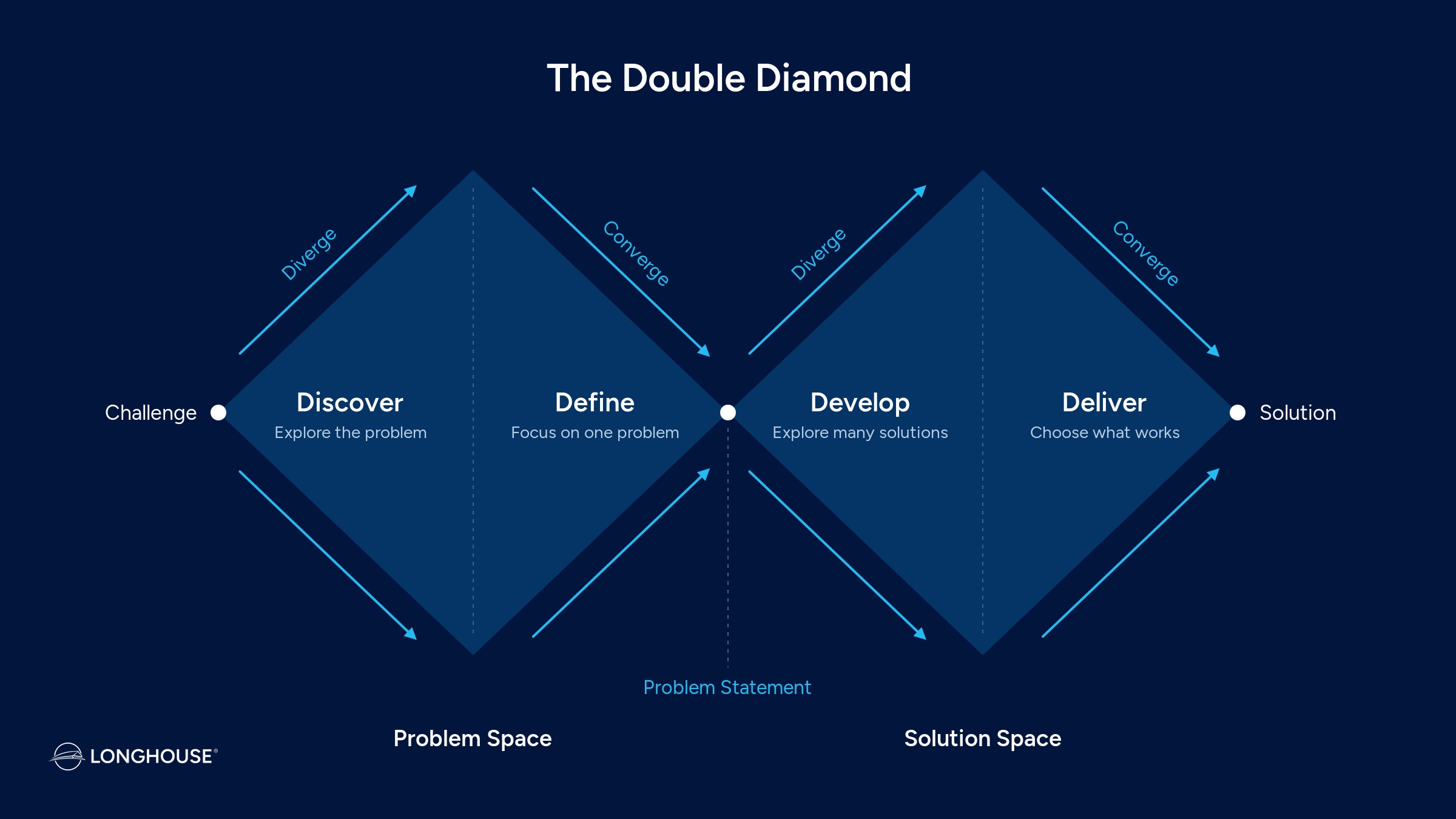
The Double Diamond is a four-stage design thinking model (Discover, Define, Develop and Deliver) that helps teams understand a problem before solving it.
Design thinking is the practice of putting the problem before the solution. It’s a structured way to understand what gets in the way of success, and test solutions before committing to them.
Every object around us was designed by someone. The chair you are sitting in, the light switch on the wall and the steps to log in this morning all came from design decisions.
Designers were first to use it, and today it’s embraced by business and community leaders everywhere. If you lead a team, serve customers or manage a product, you’re making design decisions already.
Your hiring process is designed, along with your weekly meeting, and the steps you take to submit payroll.
The history of design thinking and the Double Diamond
We are all designers
In the 1960s, researchers studied how architects and engineers solved problems and asked if their methods could be taught to people in other fields. Herbert Simon, a Nobel Prize-winning economist, described a designer as anyone who works to change an existing situation into a preferred one. By that definition, we are all designers.
Problems we face tend to share two traits. They’re tied to human behaviour, and they rarely have a single correct answer. Since there is no single answer to find, the most useful approach is to define the problem, try an idea, learn from it and adjust. In 2004, the UK Design Council mapped this approach into a diagram made of two diamonds, known today as the Double Diamond.
How design thinking works in business
Good questions uncover the problem
Design thinking starts with asking good questions. Here is an example:
A local coffee shop has long lines every morning, and customers start to mention the wait. Most of us would conclude the shop needs more staff behind the counter, which is a large investment.
The owner, using design thinking, could ask a few questions first:
Where does the line slow down? What are customers doing while they wait?
Spending a few mornings watching the line shows a different cause:
Drinks are made quickly once an order is placed. Most of the wait happens at the till, where customers see the menu for the first time and take a little longer deciding*.*
Once the problem is defined, the solution is straightforward. They added more opportunities to view the menu before ordering and the shop was able to serve people faster.
The five stages of design thinking
We see the same pattern in businesses and organizations.
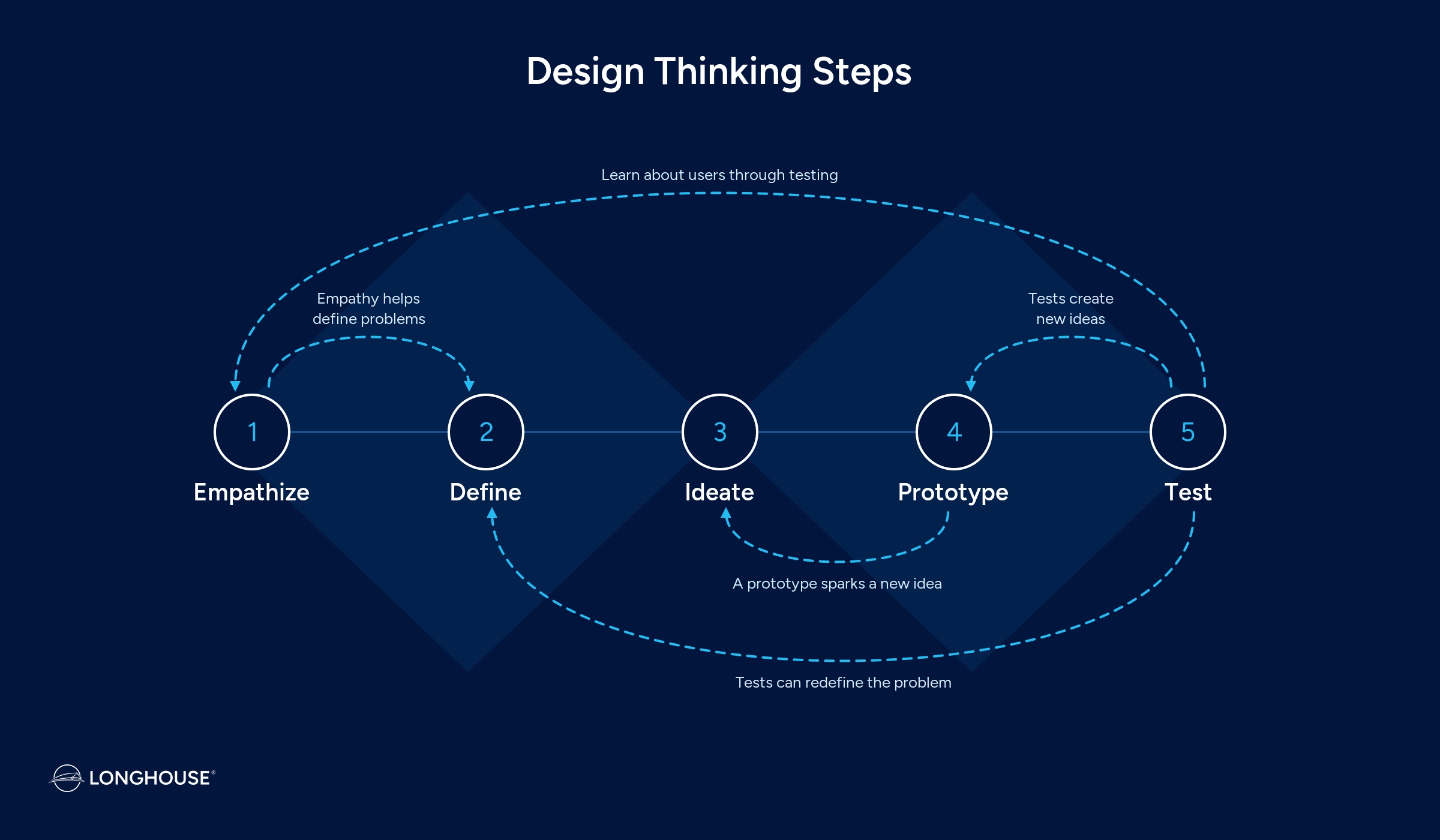
Our team followed this process when we recently implemented a new initiative. We discovered that our main tool didn’t support the tracking we needed. The team member responsible for building the solution first needed to Empathize with the people who would use it (in this case, our sales team). From there, we could Define the problem.
A brainstorming session helped us Ideate, then we broke out to think independently before coming back with new ideas. We built the strongest idea as a Prototype, a minimum viable product (MVP), which is the simplest working version of a solution that people can give feedback on. Then we shared it with the sales team to Test it.
We moved back and forth through these steps several times, widening our thinking, narrowing it again, and returning to earlier steps whenever we learned something new (testing will always unveil something new).
Asking good questions turns assumptions into a defined problem, which makes the solution easier to find. The Double Diamond gives a simple structure to follow this process.
The four stages of the Double Diamond
Open up, then narrow down
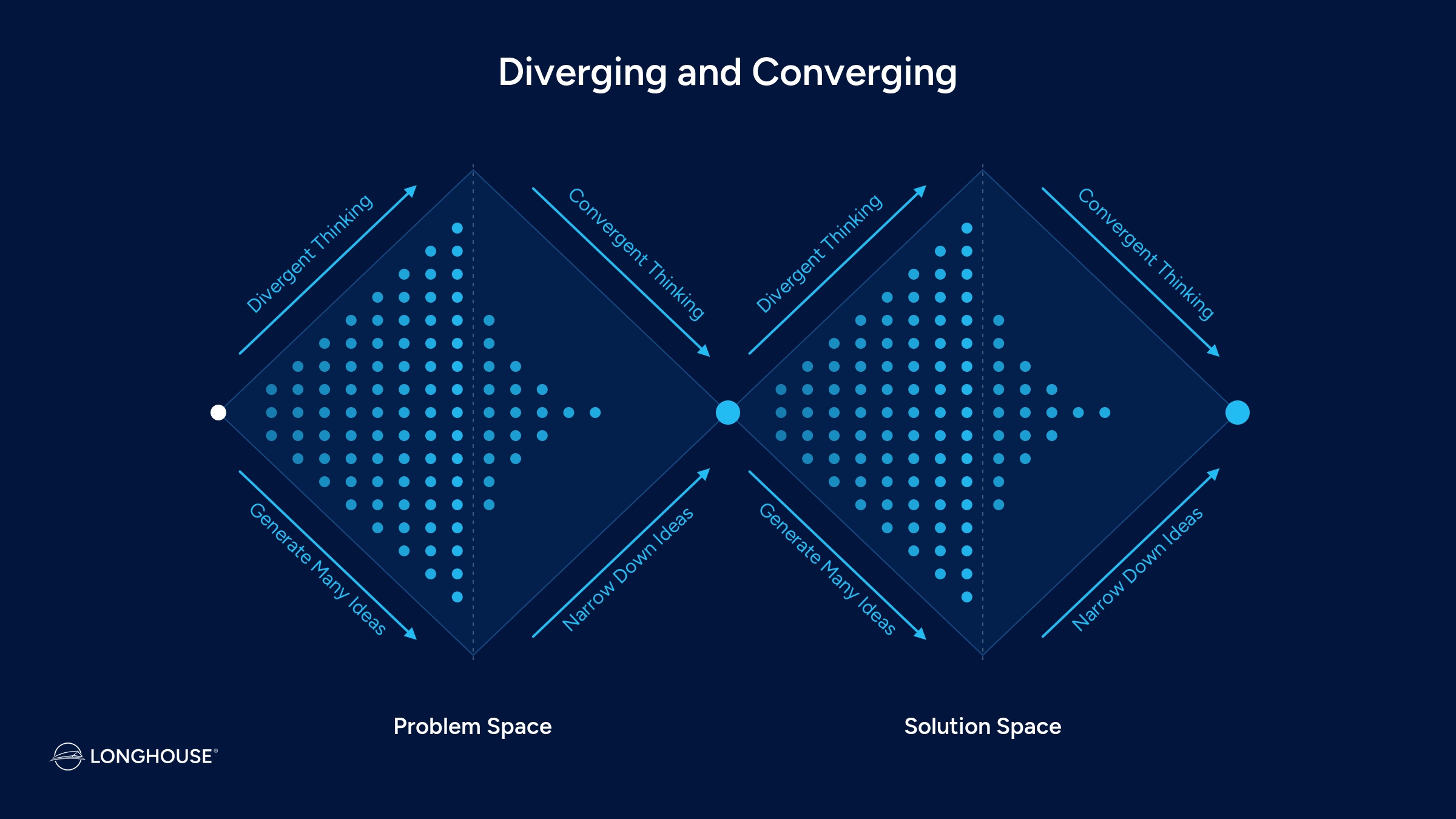
The Double Diamond describes the process of diverging and converging. The first diamond focuses on the problem, and the second focuses on the solution.
The first stage is Discover.
Learn as much as possible. This usually means having conversations, observing and researching. It can feel slow, but it helps us avoid solving the wrong problem. A survey published in Harvard Business Review asked senior executives from companies across 17 countries about this. It showed that 85 percent agreed their organizations were not good at diagnosing problems, and 87 percent said this came at a significant cost.
For a business, Discover might include:
- Customer conversations
- Reviewing sales or financial data
- Walking through the customer journey
The second stage is Define.
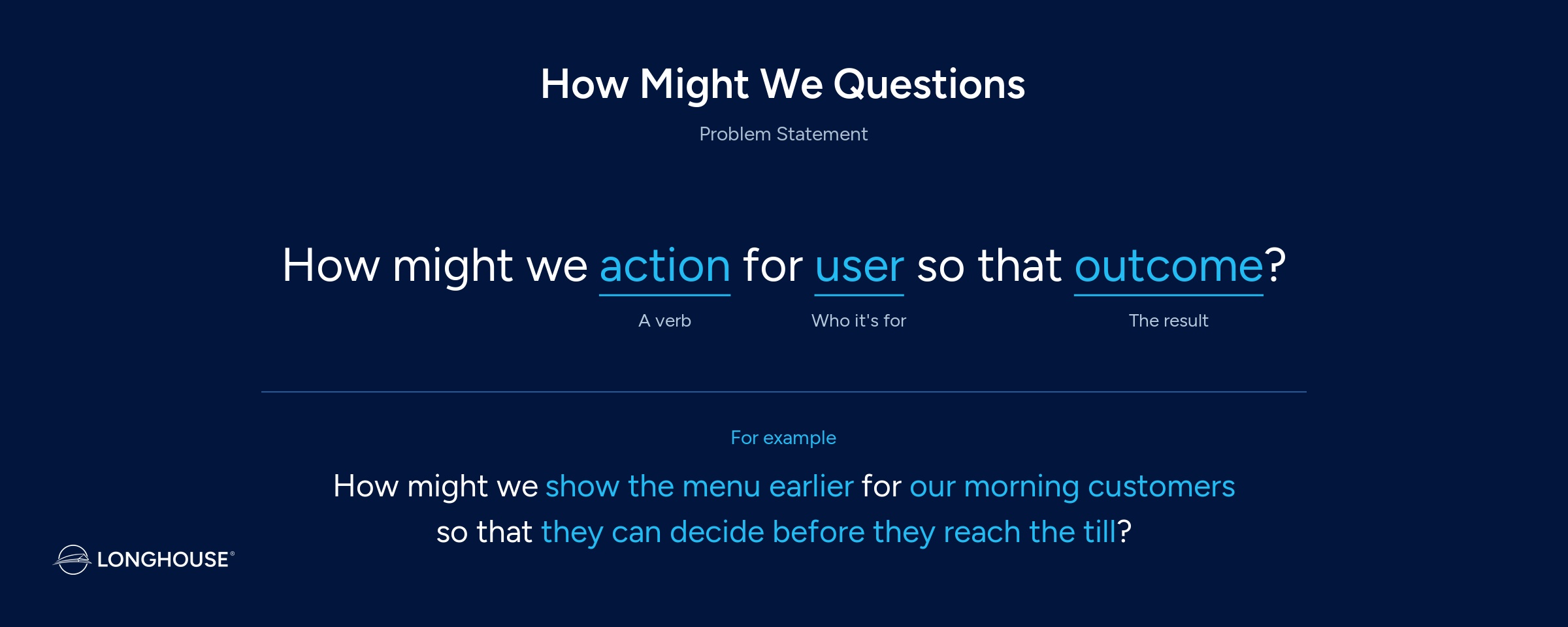
Narrow it down into a statement of the problem. A good problem statement is specific enough that we can tell whether a solution works. It also includes how success is measured. For example, “improve our customer experience” becomes “How might we reply to new inquiries within one day, instead of three, so that potential customers can book in sooner?”
The third stage is Develop.
With the problem defined, come up with many possible solutions. In some meetings, an overwhelming amount of ideas can be shared, and it might feel like you’re giving the problem all the energy you have. When that happens, it can help to physically diverge. Our team steps away from the table and spends time thinking on our own. We return to the conversation feeling energized and focused (physically converging) and choose the ideas that answer the problem statement best.
Develop is also where testing comes before investing. A small test with a few customers, or a trial with one team, shows which idea works before committing more time and resources to it.
The fourth stage is Deliver.
Test the solutions and learn from results, and refine them until one is ready to launch. After launch, choose a few metrics to track so the solutions can continue to improve.
Design thinking for business and community leaders
Design thinking applies to every team
- Service business: The most frustrating part of working together happens during scheduling, before the first meeting.
- Retail store: Customers leave without buying because they can’t find someone to answer sizing questions.
- Finance team: Month-end reporting takes ten days because the same numbers are entered in three places.
Understanding the problem saves time
Having a “problem” is not fun for anyone, but making progress should start with talking about what it actually is.
When everyone agrees on a defined problem, meetings tend to be shorter and conversations are more productive. Testing a rough version of an idea makes new ideas less risky to try, and safer to suggest. Sketching it out can show whether an idea works right away, which is a much smaller investment than building the full version. A five-year study McKinsey did of 300 public companies showed that the companies strongest in design grew their revenue 32 percentage points faster than their industry peers.
Design thinking is most useful when a problem:
- Is unclear or poorly understood
- Several teams are impacted
- Involves a large investment
Investing time to understand the problem before committing resources lowers risk and reduces rework. It also makes it easier for the people involved to support the final decision, since they helped create it.
Design thinking helps us understand what needs us most
As busy leaders, we often feel pressure to move straight to a solution. A problem comes up, we choose a fix, and we move on. Sometimes it works, but the problem may come up again because the first fix only addressed a symptom.
Design thinking takes a little more time at the start and wins back time later. Well-defined problems leads to fewer rounds of revisions hitting more goals. It helps us understand what needs us most in the first place.
How to get started with Design Thinking and the Double Diamond Method
Every busy leader has to decide where their own time should go, and the first diamond is a good place to start. You can try it in your next meeting:
- Spend the first few minutes on the problem only.
- Agree on a one-sentence problem statement.
- Then open the floor for ideas.
At Longhouse, this approach is used with our partners across Branding, Web Design, Advertising and SEO & AEO. Before your brand, website or strategy is created, we understand who it’s for and the problem we’re solving. Understanding the problem first helps us save time coming to the solution, so busy business and community leaders can win back their time and focus on what needs them most.


